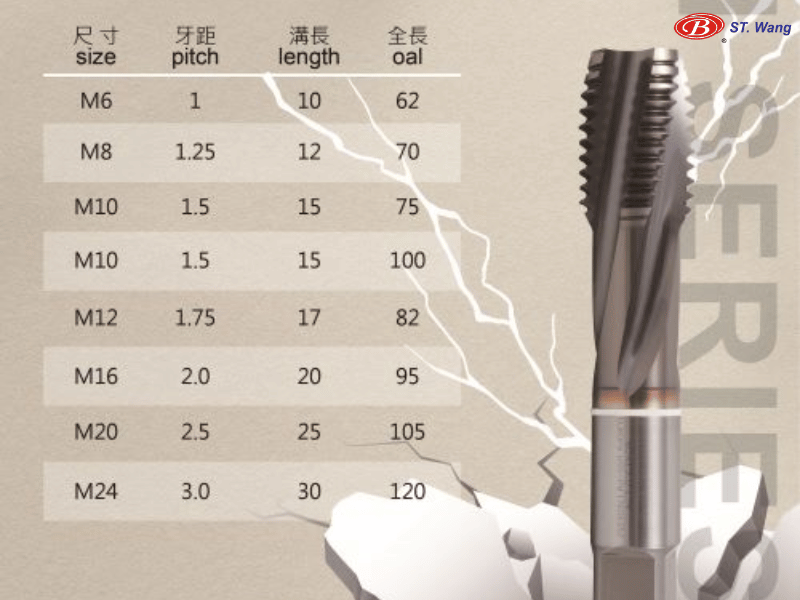
How to Choose a High-Performance Spiral Tap for CNC Turning: Solving Hard Material Tapping Pain Points
In CNC machining and mold manufacturing, tapping is often treated as a routine process—until the material changes. Once you start tapping quenched and tempered steel or mold steel in the 25–45 HRC range, common problems quickly arise: broken taps, unstable thread quality, rapid tool wear, and unpredictable tool life.
These issues are not just tooling problems—they directly affect cycle time, scrap rate, and overall production stability.
At SHANG TZANG WANG ENTERPRISE CO., LTD. (STWANG), a leading cutting tool manufacturer based in Taiwan with over three decades of experience in high-performance tooling solutions, we understand these challenges firsthand. Our High-Performance Spiral Taps are engineered specifically to address the real pain points machinists face when tapping difficult-to-cut, high-hardness materials.
In this article, we’ll walk through the typical tapping challenges and explain how a high-performance spiral tap can overcome them.
1. Why Standard Taps Fail in Hardened and Pre-Hardened Steels
One of the biggest risks when tapping harder steels is sudden tap breakage. Common causes include:
- High cutting resistance
- Rapid edge wear
- Heat buildup
- Edge chipping
- Insufficient core strength
- Torque spikes during chip congestion
Standard HSS taps often wear quickly or fail catastrophically under these conditions.
High-Performance Spiral Taps from STWANG are typically made from powder high-speed steel (PM-HSS) with optimized geometry. Compared to conventional HSS, PM-HSS offers:
- Finer, uniform grain structure
- Higher wear resistance
- Better hot hardness
- Stronger edge stability
- Improved resistance to micro-chipping
This gives the tap a much stronger safety margin under high load conditions, significantly reducing the risk of unexpected breakage and ensuring stable performance in high-hardness materials.
2. Poor Chip Evacuation in Blind Holes: A Common CNC Pain Point
Chip control is one of the most critical factors in tapping success—especially in blind holes. When chips are not evacuated efficiently, problems such as:
- Chip packing
- Torque spikes
- Thread damage
- Tool seizure
- Sudden tap failure
can occur.
Spiral taps, especially those with a moderate spiral angle like STWANG’s 15° design, help lift chips out of the hole more effectively. The advantages include:
- Efficient chip evacuation upward
- Maintained cutting edge strength
- Reduced chip clogging
- Improved stability in harder materials
This makes them particularly suitable for blind-hole tapping in mold steels and quenched steel applications.
3. Extremely Short Tool Life: A Hidden Cost in Production
In difficult materials, standard taps may fail after only a few holes. Frequent tool changes increase downtime and disrupt workflow.
STWANG High-Performance Spiral Taps are engineered for durability through:
- Advanced PM-HSS substrate
- Cutting edge geometry optimized for high-hardness materials
- Enhanced wear and heat resistance
The result is:
- More predictable tool life
- Higher hole counts per tap
- Less unplanned downtime
- Better process stability
This consistency is particularly valuable for CNC machining centers running high-volume production.
4. Inconsistent Thread Quality in Mold and Tool Steels
Thread quality is critical in mold bases, tooling plates, and precision components. However, harder materials often cause challenges such as:
- Micro-chipping at the cutting edge
- Torn thread surfaces
- Incomplete thread form
- Size variation
High-performance spiral taps maintain edge integrity longer and produce:
- Cleaner thread flanks
- More consistent pitch accuracy
- Better surface finish
- Improved thread gauge results
This is especially important in industries where thread reliability directly affects assembly quality and product performance.
5. Material Range Where High-Performance Spiral Taps Excel
High-Performance Spiral Taps with a balanced 15° spiral angle and a PM-HSS substrate are especially suitable for:
- Quenched and tempered steels
- Mold steels
- Alloy steels in the 25–45 HRC range
- Difficult-to-cut structural steels
- Higher strength mechanical components
These tools are commonly used in:
- CNC machining centers
- Mold and die shops
- Fixture and tooling manufacturing
- Precision mechanical parts production
STWANG’s High-Performance Spiral Tap series is engineered with these applications in mind—to provide both performance and predictability.
6. When Upgrading Your Tap Makes More Sense Than Adjusting Parameters
When tapping performance becomes unstable, many shops first try adjusting cutting parameters:
- Slowing spindle speed
- Reducing feed rate
- Increasing coolant flow
- Adjusting peck tapping cycles
While these adjustments can help, tool design and material often matter more, especially in higher-hardness steels.
Upgrading to a high-performance spiral tap designed for these conditions often delivers greater improvements than parameter tuning alone. Benefits include:
- Lower breakage risk
- Longer tool life
- Better thread consistency
- More stable torque behavior
For shops regularly tapping 25–45 HRC materials, a well-engineered spiral tap is not just a premium option—it is often the more economical choice over time.
About SHANG TZANG WANG ENTERPRISE CO., LTD.
SHANG TZANG WANG ENTERPRISE CO., LTD. (STWANG) has been a trusted cutting tools manufacturer since 1987, specializing in high-performance tooling solutions for difficult-to-machine materials. Our product range includes:
- High-Performance Spiral Taps for hardened materials
- Threading tools for both internal and external applications
- Carbide tools for mold, automotive, and precision machining
- Customized solutions based on customer requirements
With decades of technical expertise and a commitment to performance, STWANG supports customers across applications requiring high precision, long tool life, and stable production results.
Conclusion
Choosing the right tap for high-hardness materials makes a significant difference in CNC operations. A well-designed high-performance spiral tap—such as those offered by SHANG TZANG WANG ENTERPRISE CO., LTD.—can transform tapping from a bottleneck into a reliable, repeatable process.
By understanding tapping challenges and selecting tools engineered for hard materials, manufacturers can improve production efficiency, reduce tool costs, and maintain high thread quality across batches.
For more information, please refer to our catalog or contact us directly.