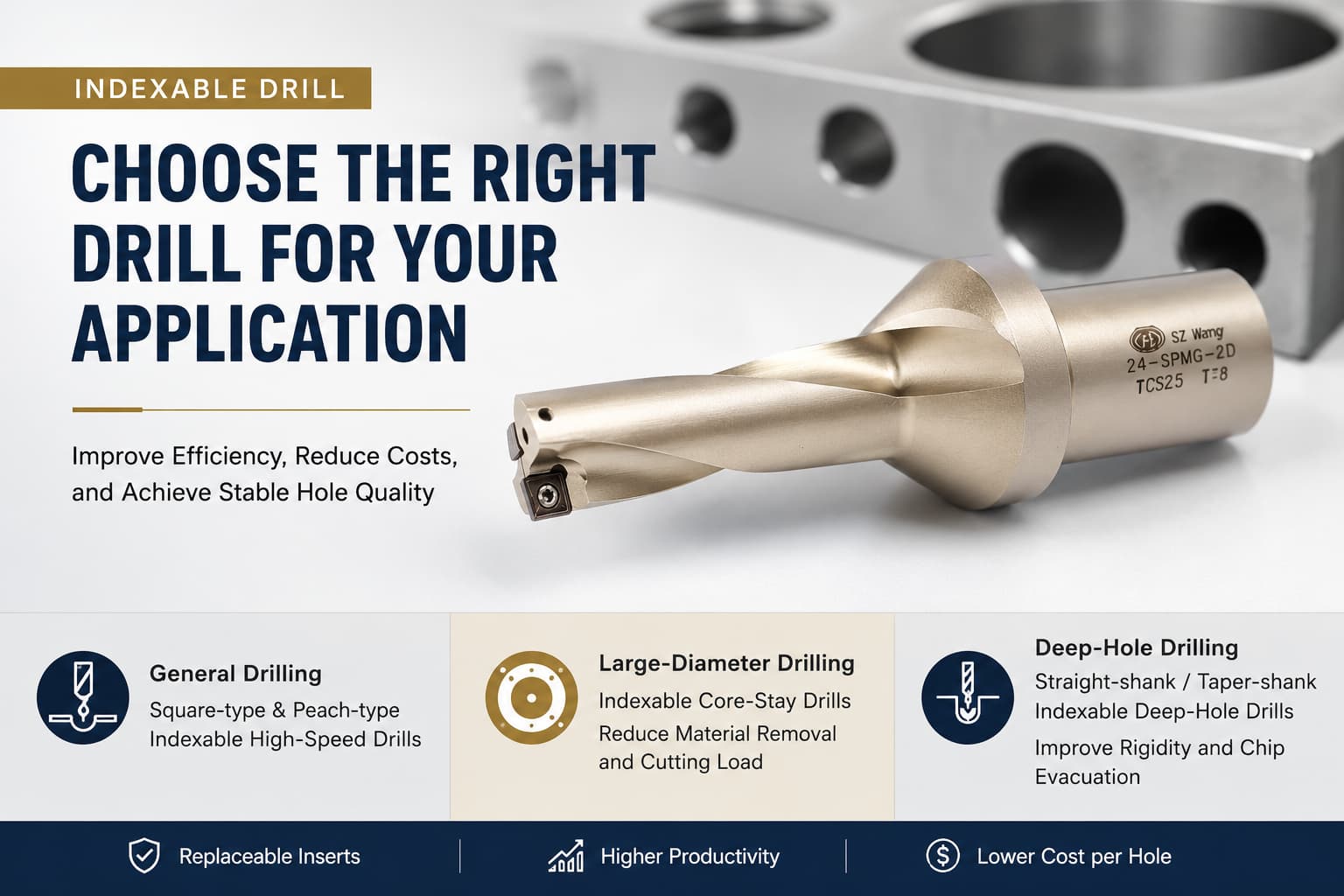
Which Indexable Drill Is Right for Your CNC Machining Application?
Choosing an indexable drill is not simply a matter of matching the drill diameter to the required hole size. Hole depth, machine rigidity, spindle capability, chip evacuation, workpiece material, and production volume can all affect which drilling solution is the most suitable.
Using the wrong drill may lead to unstable hole quality, excessive cutting load, poor chip evacuation, premature insert wear, or unnecessary machining time.
SHANG TZANG WANG ENTERPRISE CO., LTD. has been developing cutting tools in Taiwan since 1987. Our indexable drill series includes square-type and peach-type indexable high-speed drills, core-stay drills, and indexable straight-shank / taper-shank deep-hole drills, providing different drilling solutions according to machining requirements.
This guide focuses on one practical question: Which indexable drill should you choose for your CNC machining application?
Start with the Machining Requirement, Not Just the Diameter
Before choosing an indexable drill, manufacturers should first check the complete machining conditions.
- Required hole diameter
- Hole depth
- Workpiece material
- Machine type
- Spindle power and rigidity
- Coolant supply
- Chip evacuation conditions
- Production quantity
Two holes with the same diameter may require completely different tools if one is shallow and the other is a deep hole.
For this reason, the best indexable drill is the one that matches the complete machining condition—not simply the nominal diameter.
If you are still unfamiliar with the basic structure and operating principle of this type of tool, you can first read our previous guide: What Is an Indexable Drill? A Comprehensive Guide to Its Design and Benefits.
Quick Indexable Drill Selection Guide
| Machining Requirement | Recommended Drill Type | Main Selection Focus |
|---|---|---|
| General productive drilling | Square-type or peach-type indexable high-speed drill | Efficiency, insert economy, machine conditions |
| Large-diameter drilling | Indexable core-stay drill | Reduced material removal and cutting load |
| Deep-hole drilling | Straight-shank / taper-shank indexable deep-hole drill | Rigidity, chip evacuation, machine interface |
For General CNC Hole Machining: Indexable High-Speed Drills
For general small- to medium-diameter drilling applications, an indexable high-speed drill is often the first option to consider.
Unlike a conventional solid drill, the cutting inserts can be replaced when worn while the drill body remains in service. This is particularly useful in repetitive CNC production where tool replacement time and tooling cost need to be controlled.
SHANG TZANG WANG offers different indexable high-speed drill configurations, including:
- Square-type indexable high-speed drills
- Peach-type indexable high-speed drills
The correct choice depends on the specific drill specification and machining conditions rather than the insert shape alone.
Manufacturers should evaluate:
- Hole diameter
- Workpiece material
- Required hole depth
- Cutting conditions
- Machine rigidity
- Recommended insert and drill-body combination
If the goal is stable, repeated hole production with replaceable cutting edges, these indexable high-speed drills can provide an efficient alternative to replacing an entire drill after wear.
For additional information about the productivity and cost benefits of this tool design, see 5 Advantages of Using Indexable Drills for High-Performance Machining.
For Large-Diameter Holes: Consider a Core-Stay Drill
As the required hole diameter increases, full-section drilling requires the tool to remove a much larger volume of material.
This can increase:
- Cutting resistance
- Spindle load
- Chip volume
- Machining time
An indexable core-stay drill uses a different approach. Instead of removing the entire cross-section of the hole, it cuts around the circumference and leaves a solid core in the center.
This makes it particularly useful when large-diameter drilling creates excessive cutting load.
For manufacturers already evaluating large-hole machining, the main question is not simply whether to use a larger drill. In some applications, changing to a core-stay drilling method can provide a more efficient solution.
Because we have already covered this subject in detail, you can continue with Large-Diameter Drilling Problems in CNC Machining and How Core-Stay Drills Improve Efficiency rather than treating the core-stay drill as just a larger conventional drill.
For more information about how Rapid Core-Stay Drills are used on different machine tools, see Applications of Rapid Core-Stay Drills in Modern CNC Machining.
For Deep Holes: Hole Depth Changes the Selection Criteria
Deep-hole drilling introduces additional challenges that are less critical in shallow-hole machining.
As hole depth increases, manufacturers need to pay more attention to:
- Tool overhang
- Drill rigidity
- Chip evacuation
- Coolant delivery
- Cutting stability
- Machine and holder compatibility
A standard indexable drill that works well in shallow holes may not provide the same performance when the depth increases significantly.
For these conditions, SHANG TZANG WANG provides indexable straight-shank and taper-shank deep-hole drills.
The shank type should be selected according to the machine interface, holder system, required rigidity, and actual drilling conditions. This topic involves different considerations from ordinary indexable drilling, so it is worth evaluating deep-hole applications separately rather than selecting a drill based only on diameter.
3 Common Mistakes When Choosing an Indexable Drill
1. Selecting Only by Hole Diameter
Diameter is important, but it does not tell you whether the drill is suitable for the required depth, machine, material, or production volume.
2. Ignoring Machine Conditions
Spindle capability, toolholding rigidity, coolant supply, and workpiece clamping all affect drilling performance.
Even the correct drill may perform poorly if the machine setup cannot support the required cutting conditions.
3. Looking Only at Initial Tool Price
For repeat production, manufacturers should also consider:
- Insert consumption
- Tool change frequency
- Machine downtime
- Cycle time
- Drill-body reuse
- Cost per finished hole
A lower-priced drill does not always result in a lower machining cost.
How to Make a Better Indexable Drill Selection
Before choosing an indexable drill, answer these questions:
- What hole diameter is required?
- How deep is the hole?
- What material is being machined?
- Which machine will be used?
- What toolholding system is available?
- How will coolant reach the cutting zone?
- How will chips be evacuated?
- Is the application occasional or repetitive production?
Once these conditions are clear, it becomes much easier to determine whether an indexable high-speed drill, core-stay drill, or deep-hole drilling solution is the better choice.
SHANG TZANG WANG Indexable Drilling Solutions
SHANG TZANG WANG ENTERPRISE CO., LTD. provides multiple indexable drilling solutions for different machining requirements, including:
- Square-type indexable high-speed drills
- Peach-type indexable high-speed drills
- Core-stay drills
- Straight-shank / taper-shank indexable deep-hole drills
Rather than using one drilling design for every application, manufacturers can select the appropriate tool according to hole size, depth, machine conditions, and production requirements.
You can view the available configurations in our Indexable Drill Series.
Conclusion
There is no single indexable drill that is ideal for every application.
For general productive drilling, square-type or peach-type indexable high-speed drills may be appropriate. For large-diameter holes, a core-stay drill can reduce the amount of material that must be removed. For deep-hole applications, rigidity, chip evacuation, coolant delivery, and machine compatibility become the primary selection factors.
The key is to choose the drill according to the hole and machining conditions, rather than diameter alone.
If you are unsure which indexable drill is suitable for your machining application, contact SHANG TZANG WANG ENTERPRISE CO., LTD. with your hole diameter, depth, workpiece material, machine type, and machining conditions. We can help you evaluate the appropriate drilling solution.
For additional specifications, please refer to our Indexable Drill Series and product catalog.