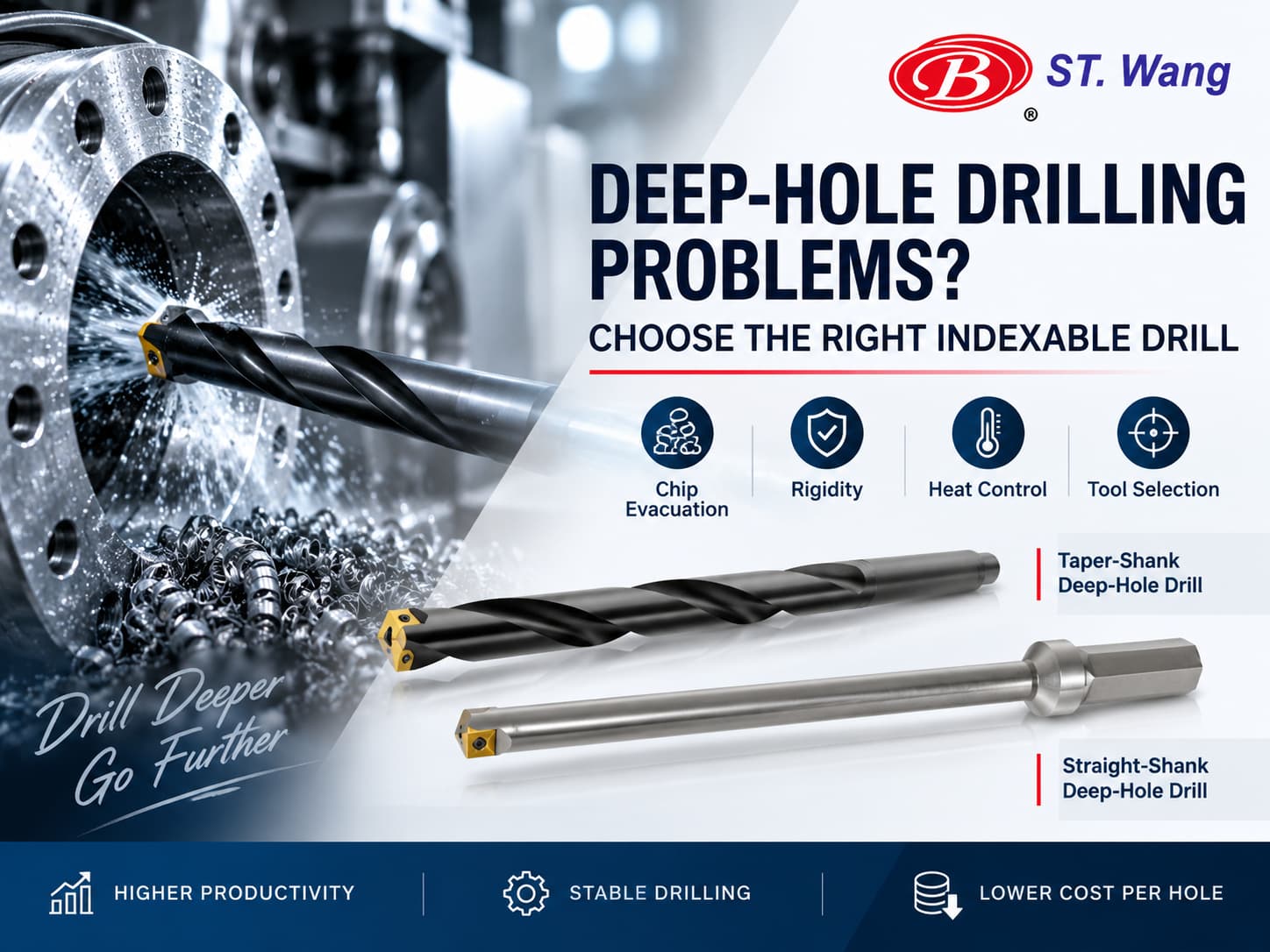
Deep-Hole Drilling Problems: How to Choose the Right Indexable Drill
Deep-hole drilling is much more demanding than simply drilling a longer hole. As drilling depth increases, chip evacuation becomes more difficult, tool rigidity decreases, cutting heat becomes harder to control, and small setup errors can have a greater effect on hole quality.
For manufacturers dealing with deep-hole machining, choosing the correct indexable drill is therefore critical.
At SHANG TZANG WANG ENTERPRISE CO., LTD., we provide indexable straight-shank and taper-shank deep-hole drilling solutions for applications where hole depth, rigidity, chip evacuation, coolant delivery, and machine compatibility are key considerations.
This article explains the most common deep-hole drilling problems and what manufacturers should evaluate when selecting an indexable deep-hole drill.
Common Problems in Deep-Hole Drilling
Before selecting the tool, it is important to understand why deep-hole drilling becomes unstable.
The most common problems include:
- Poor chip evacuation
- Reduced tool rigidity
- Excessive cutting heat
- Unstable hole quality
- Higher risk of insert wear or breakage
These issues become more significant as the drilling depth increases. A tool that works well in a shallow-hole application may not provide the same stability when the hole becomes much deeper.
1. Poor Chip Evacuation
In shallow drilling, chips only need to travel a short distance before leaving the hole. In deep-hole drilling, however, chips must move through a much longer path before they can exit the cutting zone.
If chip evacuation is insufficient, chips may accumulate around the cutting edge and cause:
- Increased cutting resistance
- Higher torque
- Cutting-edge damage
- Poor hole surface quality
- Unexpected tool failure
For this reason, chip evacuation should be considered from the beginning of the tool-selection process rather than only after a machining problem occurs.
Coolant delivery can play an important role in deep-hole chip evacuation. For a more detailed explanation of how coolant reaches the cutting zone and helps remove chips, see our article What Is an Internal Coolant Carbide Drill? Understand Its Mechanism and Applications with STWANG.
2. Tool Rigidity Becomes More Important
As the effective tool length increases, the drilling system becomes more sensitive to deflection and vibration.
Insufficient rigidity may result in:
- Hole deviation
- Poor roundness
- Unstable hole diameter
- Vibration
- Premature insert wear
When evaluating a deep-hole drill, manufacturers should not look only at the cutting insert. The entire machining system—including the drill body, shank, holder, spindle, and workpiece clamping—affects drilling stability.
Excessive tool overhang should also be avoided whenever possible because longer overhang generally reduces system rigidity and increases sensitivity to vibration.
3. Cutting Heat Is Harder to Control
Deep inside the hole, coolant has more difficulty reaching the cutting edge, while cutting friction and chip formation continue to generate heat.
If heat is not controlled properly, it may lead to:
- Faster insert wear
- Poor surface finish
- Reduced dimensional stability
- Cutting-edge damage
Adequate coolant delivery and suitable cutting conditions are therefore essential for stable deep-hole machining.
If your application involves difficult-to-machine materials, internal coolant can become even more important. Our article Top 5 Materials Best Suited for Internal Coolant Carbide Drills explains how internal coolant can support chip removal and heat control in stainless steel, titanium alloys, nickel-based alloys, hardened steels, and aluminum applications.
4. Hole Quality Can Become Unstable
A drill may produce an acceptable hole at a shallow depth but lose stability as the drilling depth increases.
Common deep-hole quality problems include:
- Hole drift
- Diameter variation
- Rough internal surfaces
- Poor straightness
These problems are often related to a combination of tool rigidity, alignment, chip evacuation, coolant delivery, cutting parameters, and tool selection.
This is why deep-hole drilling should be treated as a complete machining system rather than simply choosing a drill with enough length.
What Should You Check Before Choosing an Indexable Deep-Hole Drill?
Before selecting an indexable deep-hole drill, manufacturers should evaluate the complete machining conditions.
- Required hole diameter
- Required hole depth
- Workpiece material
- Machine type
- Spindle interface
- Toolholding system
- Available coolant method
- Chip evacuation conditions
- Required production quantity
If you are still evaluating whether an indexable drill is the right drilling system for your application, our earlier article What Is an Indexable Drill? A Comprehensive Guide to Its Design and Benefits provides an overview of indexable drill structure, replaceable inserts, and general applications.
Straight-Shank vs. Taper-Shank Indexable Deep-Hole Drills
SHANG TZANG WANG offers both straight-shank and taper-shank indexable deep-hole drilling solutions.
The main difference is how the drill integrates with the machine and toolholding system. Neither design is universally better; the correct choice depends on the complete machining setup.
| Selection Factor | Straight-Shank Deep-Hole Drill | Taper-Shank Deep-Hole Drill |
|---|---|---|
| Shank Design | Cylindrical straight shank | Tapered shank |
| Machine Compatibility | Depends on the available holder system | Suitable for compatible taper interfaces |
| Toolholding | Flexible with an appropriate holder | Direct or taper-based mounting |
| Main Selection Concern | Holder rigidity and clamping stability | Machine taper and interface compatibility |
| Typical Consideration | CNC and compatible production setups | Machines designed for taper-shank tooling |
The shank type should therefore be selected according to:
- Machine interface
- Required rigidity
- Toolholding method
- Hole depth
- Actual drilling conditions
Why Replaceable Inserts Matter in Deep-Hole Production
An indexable deep-hole drill equipped with replaceable inserts provides an important economic advantage in repetitive production.
When the cutting edge reaches its wear limit, manufacturers can replace the insert rather than replacing the complete drill body.
This can help:
- Reduce complete-tool replacement costs
- Shorten tool maintenance time
- Simplify tool inventory management
- Keep the drill body in service longer
- Control cost per finished hole
For manufacturers comparing indexable drilling with other drill materials and structures, you may also refer to HSS vs. Tungsten Carbide Drill Bits – How to Pick the Right One for Your Needs, which explains how machine rigidity, production volume, material, and cost per hole affect drill selection.
5 Selection Mistakes to Avoid
1. Using a Standard Drill Simply Because the Diameter Fits
The correct diameter does not mean the drill is suitable for the required hole depth.
As the hole becomes deeper, chip evacuation, rigidity, coolant delivery, and stability become increasingly important.
2. Ignoring Tool Overhang
Long tool overhang reduces rigidity and increases the risk of vibration, deflection, and hole deviation.
Use the shortest practical tool configuration that can safely reach the required depth.
3. Ignoring Chip Evacuation
Deep-hole drilling generates chips far from the hole entrance. If the chips cannot move out of the hole efficiently, cutting resistance and heat may increase rapidly.
4. Selecting the Shank Without Considering the Machine
Straight-shank and taper-shank tools should be matched to the actual machine interface and toolholding system.
Choosing a shank style independently from the machine setup may result in insufficient rigidity or unnecessary setup complexity.
5. Increasing Cutting Parameters Before Solving Stability Problems
Higher speed or feed cannot compensate for poor rigidity, alignment, coolant delivery, or chip evacuation.
In some cases, increasing the cutting parameters before solving these underlying problems can make tool wear and hole-quality problems worse.
A Better Deep-Hole Drill Selection Process
A practical deep-hole drill selection process is:
- Confirm the required hole diameter and depth.
- Check the workpiece material.
- Confirm the machine and spindle interface.
- Evaluate the available toolholder.
- Check system rigidity and tool overhang.
- Confirm coolant delivery to the cutting zone.
- Plan chip evacuation.
- Select the appropriate drill body and insert.
- Establish suitable cutting parameters.
This approach helps reduce the risk of selecting a tool based only on diameter and provides a more complete foundation for stable deep-hole machining.
Deep-Hole Drilling Solutions from SHANG TZANG WANG
SHANG TZANG WANG ENTERPRISE CO., LTD. has developed cutting tools for different machining requirements since 1987. Our drilling product range includes indexable drilling systems, core-stay drills, carbide drills, and large-diameter indexable deep-hole drilling solutions.
For deep-hole applications, our solutions include:
- Indexable straight-shank deep-hole drills
- Indexable taper-shank deep-hole drills
- Replaceable cutting inserts
These tools are intended for manufacturers that need to improve deep-hole machining stability while keeping tool replacement and production costs under control.
If you would like to better understand the general productivity advantages of replaceable-insert drilling systems, see 5 Advantages of Using Indexable Drills for High-Performance Machining.
Conclusion
Deep-hole drilling problems are rarely caused by only one factor. Poor chip evacuation, insufficient rigidity, cutting heat, machine compatibility, and toolholding conditions can all affect the final result.
That is why choosing an indexable deep-hole drill requires more than matching the hole diameter.
Straight-shank and taper-shank designs should be selected according to the machine interface, rigidity requirements, hole depth, coolant conditions, and complete machining setup.
If you are experiencing unstable deep-hole drilling, chip evacuation problems, or excessive tool wear, contact SHANG TZANG WANG ENTERPRISE CO., LTD. with your hole diameter, drilling depth, workpiece material, machine type, and toolholding conditions. Our team can help you evaluate the appropriate indexable deep-hole drilling solution.
For additional specifications and product information, please refer to our product catalog or visit the SHANG TZANG WANG technical articles for more machining guides.